HomeShopFreediving › Freediving Masks

Freediving Masks

Equalising a low-volume freediving mask takes a fraction of the air that a standard diving mask requires — which matters significantly when you're conserving every breath. Frameless designs sit closest to the face, minimise drag and fold into a pocket easily between dives.

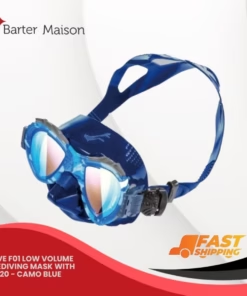
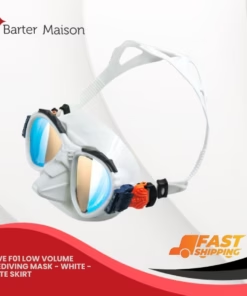
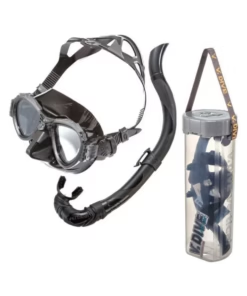
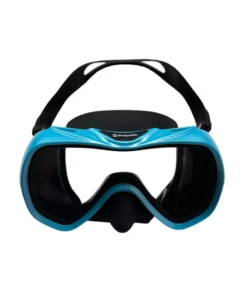
Vdive F01 Low Volume Freediving Mask with UV420 - Camo Blue
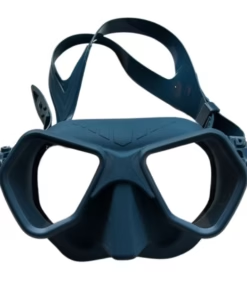
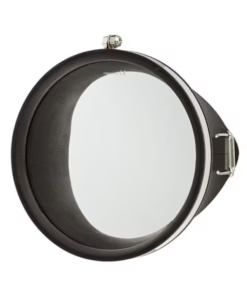
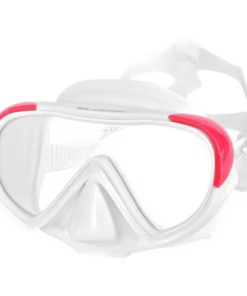
Problue MS-128R Free Diving Style Mask
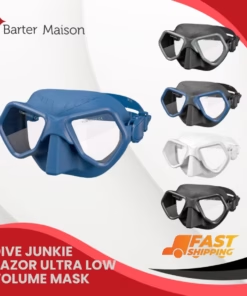
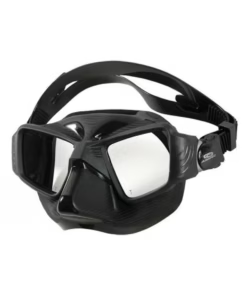
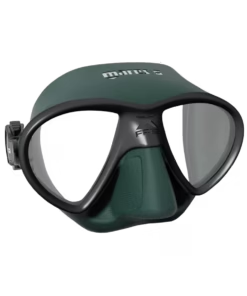
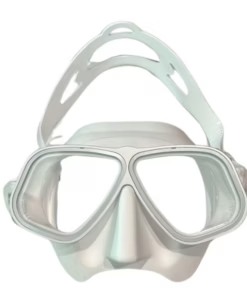
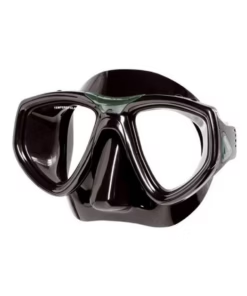
Aropec Sniper Low Volume Mask - black/black

✓  Free Shipping Over RM150|✓  Manufacturing Defect Exchange Guaranteed|✓  Expert Dive Advice Before & After Purchase|✓  100% Authentic Equipment Every Item

Filter By

Price Range


RM 40 RM 400

Filter By

Sub Categories


Filter By

Brands


Showing 1–12 of 12 products
Sort:

Expert Advice

The Freediver's Window to the Deep

Freediving masks combine the minimal air volume of a low-volume design with dark or mirrored silicone skirts that block upward light distraction. Every millilitre saved on equalisation is another metre of comfortable depth.

Ask About Freediving Masks

Skirt Colour

Dark Skirt Freediving Masks: Why Colour Blocks Distraction

Dark or mirrored silicone skirts block light entering from above — eliminating the surface glow that distracts vision when looking up during descent. Freediving photographers in particular prefer black skirts to control ambient light in the frame.

Frameless

Frameless Freediving Masks: Minimum Volume, Maximum Flexibility

Frameless masks bond the lens directly to the silicone skirt with no rigid frame — reducing volume by 30–40% vs framed equivalents. The flexible skirt conforms to facial movement during deep descents where pressure deforms a rigid frame against the face.

Mask Squeeze

Mask Squeeze: What Happens and How to Prevent It at Depth

Mask squeeze occurs when you descend without equalising the air space inside the mask through your nose — creating a vacuum that bruises the skin around the eyes. Exhale slowly into the mask on descent; equalise every 2–3m until you reach target depth.

Lens Quality

Tempered Glass vs Optical Glass Lenses in Freediving Masks

Standard tempered glass lenses distort slightly at the edges. High-grade optical glass lenses reduce distortion for underwater photographers. The practical difference is minor for pure depth freedivers — optical glass matters most to spearfishers sighting at distance.

You Might Also Like

Recommended Products

Hand-picked products based on all categories

RM270.00
RM344.00

Diving Equipment

Tusa Solla Open Heel Fins

RM617.00
RM480.00
RM1,826.00

FAQ

Frequently Asked Questions

Everything you need to know before making a purchase

What makes a freediving mask different from a standard scuba mask?
Freediving masks are designed to minimise internal volume to the absolute minimum achievable while maintaining a watertight seal, because every cubic centimetre of air inside the mask must be equalised using air exhaled from the lungs u2014 a finite resource during a breath-hold dive. Standard scuba masks have no such constraint because the diver has unlimited air from the cylinder to equalise with. A lower mask volume directly extends the depth a freediver can reach before lung volume is insufficient to continue equalising both ears and mask simultaneously.
How does a freediving mask's low internal volume benefit Malaysian breath-hold divers?
At 20 metres depth, water pressure has compressed the diver's lung volume to approximately one-third of its surface value. A high-volume mask requires significantly more air to equalise at this depth than a low-volume mask, drawing on the same compressed lung reserve that the diver needs to maintain the breath-hold. At popular Malaysian freediving depths of 15 to 25 metres, the difference between a standard-volume mask and a properly fitted low-volume freediving mask can meaningfully extend the available bottom time before the diver must ascend.
What frame styles are available for freediving masks suited to Malaysian conditions?
Frameless freediving masks that bond the lens directly to a minimal silicone skirt are the most popular configuration because they eliminate the rigid frame perimeter that adds to internal volume without contributing to the optical or sealing function. Semi-frameless designs with a minimal lower frame for nose pocket support are a middle ground that suits divers who find fully frameless masks difficult to seal on their facial profile. Fully framed freediving masks are less common and are generally avoided by experienced freedivers because the frame adds internal volume that negates the mask's primary design advantage.
How do I choose between a freediving mask and a low-volume scuba mask for Malaysian diving?
Dedicated freediving masks are optimised to the minimum possible internal volume and are the appropriate choice for serious breath-hold divers training at Malaysian sites or pursuing competitive freediving. Low-volume scuba masks provide meaningfully less air volume than standard scuba masks and suit recreational scuba divers who also snorkel or do casual breath-hold dives without requiring the absolute minimum volume that a purpose-built freediving mask achieves. If the primary use is scuba with occasional freediving, a low-volume scuba mask is the more practical single-mask choice for Malaysian conditions.
What nose pocket design allows the most comfortable mask equalisation during Malaysian freediving?
A nose pocket that positions the nostrils close to the lens allows a natural pinch grip using the thumb and forefinger without requiring the hand to reach forward significantly from the face. Freediving masks with minimal nose pockets are designed so the pocket stays close to the face throughout descent, maintaining grip accessibility at depth when the mask compresses slightly. Testing the nose pinch grip thoroughly during the fitting process u2014 with full arm extension simulating swimming position u2014 is essential before committing to a freediving mask for Malaysian depth work.
How do I maintain a freediving mask after saltwater and UV exposure at Malaysian sites?
Rinse the mask in fresh water immediately after every session, paying attention to the nose pocket interior and the minimal silicone skirt edge where salt concentrates. Freediving masks often use a thinner silicone formulation than scuba masks to achieve the lowest possible internal volume u2014 this thinner silicone is more sensitive to UV degradation from Malaysian tropical sun. Store the mask in a rigid case away from direct sunlight between sessions, as the silicone in a frameless design is particularly vulnerable to distortion from UV exposure without the protective rigid frame.