HomeShopAccessories › Compasses

Compasses

Navigation by compass is a skill, not a backup for when GPS fails — it's the foundation of underwater orienteering and a core component of the Advanced Open Water course. A liquid-filled compass with a luminous bezel and side-read window makes that skill considerably easier to develop.

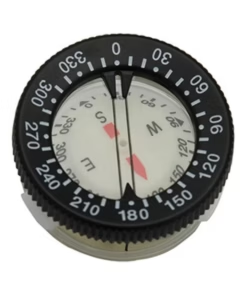
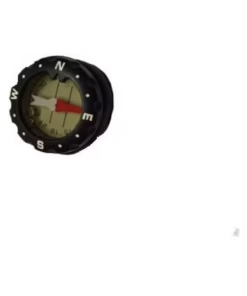
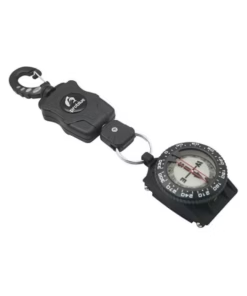
Problue GU-1300 Compass with Retractor
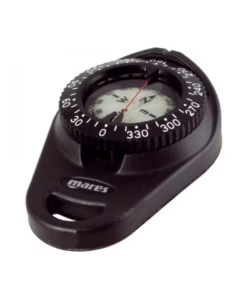
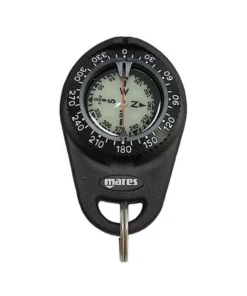
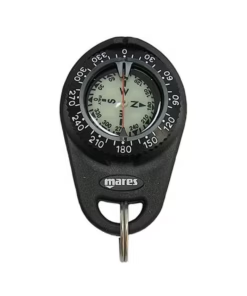
Mares Handy Compass (South) Instrument
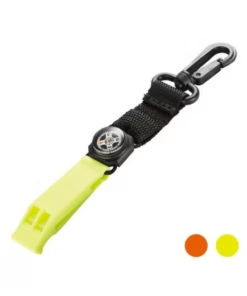
Problue GU-1290 Compass with Split Ring Bezel

✓  Free Shipping Over RM150|✓  Manufacturing Defect Exchange Guaranteed|✓  Expert Dive Advice Before & After Purchase|✓  100% Authentic Equipment Every Item

Filter By

Price Range


RM 25 RM 403

Filter By

Sub Categories


Filter By

Brands


Showing 1–20 of 22 products
Sort:

RM180.00
RM200.00
RM128.00

Accessories

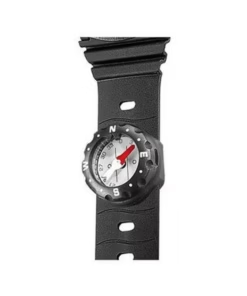
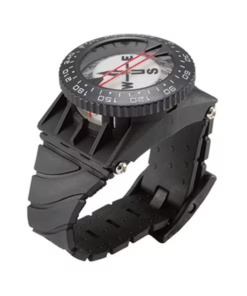
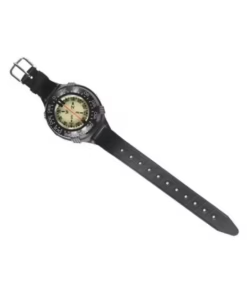
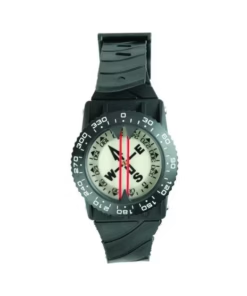
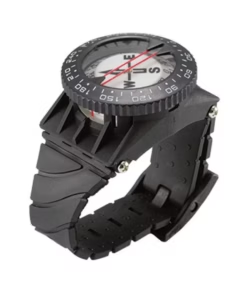
Seac Wrist Compass

RM403.00
RM135.00
RM128.00
RM135.00
RM112.00
RM249.00
RM88.64
RM139.00
RM25.00

Expert Advice

Navigate Reef, Wreck and Open Water With Confidence

A compass dive is a foundational skill that saves the drift when visibility drops or landmarks disappear. Wrist compasses and console compasses give you heading data that no dive computer can replace.

Ask About Dive Navigation

Wrist vs Console

Wrist Compass vs Console Compass: Which Is More Accurate?

Both use the same magnetic needle — the difference is mounting position. Wrist compasses suit divers who want a dedicated instrument; console compasses suit divers who prefer all gauges in one view.

Technique

The Reciprocal Heading: Core Compass Navigation for All Divers

A reciprocal heading is the reverse course — add or subtract 180°. Master the swim-out/turn/swim-back pattern and you can navigate any rectangular or out-and-back dive plan in reduced visibility.

Digital vs Analog

Digital Compass in Your Dive Computer vs Standalone Compass

Digital compasses in dive computers update slowly and tilt-compensate inconsistently. A dedicated analog compass gives instantaneous heading — divers navigating Malaysian wrecks prefer analog for reliability.

Malaysia

Compass Navigation on Malaysian Reef and Wreck Dives

Many Malaysian dive sites rely on natural navigation — reef walls and sandy slopes as reference points. A compass becomes critical when current sweeps you off the reef or visibility drops suddenly.

You Might Also Like

Recommended Products

Hand-picked products based on all categories

Wetsuits & Exposure Suits

Subgear Element XXL 3MM

RM240.00
RM72.00

Diving Mask

Mares Samurai Mask

RM56.00
RM262.00

FAQ

Frequently Asked Questions

Everything you need to know before making a purchase

Why carry a compass at Malaysian dive sites that often have visible reef reference points?
Malaysian reef sites frequently experience low-visibility conditions from plankton blooms, tidal silt, and weather-related water movement that eliminate visual reference points mid-dive without warning. Sites around Mabul and Kapalai in Sabah can see visibility drop below 5 metres during certain tidal cycles, and navigating back to the ascent point or liveaboard buoy without a compass becomes a matter of luck. A compass provides the only reliable directional reference in zero-visibility conditions and adds negligible weight and bulk to the dive configuration.
What compass mounting options suit Malaysian recreational and liveaboard diving?
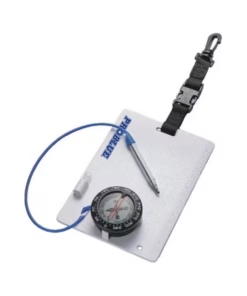
A wrist-mounted compass worn on the non-dominant wrist alongside or opposite the dive computer is the most commonly used configuration at Malaysian reef and liveaboard sites, keeping the compass accessible for quick reference without occupying a hand. Console-mounted compasses integrated into a regulator console are equally reliable and benefit from a larger display but require holding the console horizontal for an accurate reading. Compass boards u2014 a rigid slate with a compass mounted flat u2014 are used in PADI and SSI navigation specialty courses at Malaysian dive training operations but are impractical for general recreational use.
How do I take a compass bearing before diving a new Malaysian reef site?
On the surface before descent, identify the bearing from the boat or shore entry point toward the desired underwater landmark or return direction, and rotate the compass bezel to align the lubber line with the needle. Descend and swim the heading by keeping the needle within the bezel marks while maintaining horizontal trim u2014 a tilted compass gives an inaccurate reading. Record the reciprocal bearing for the return swim, which is the outward bearing plus 180 degrees, representing the direct return direction from the furthest planned point of the dive.
Why do dive compasses require hemisphere-specific calibration, and does it matter in Malaysia?
Standard liquid-filled compass needles are balanced for use in one hemisphere u2014 a compass calibrated for the northern hemisphere dips toward the bottom of the housing when used in the southern hemisphere, causing the needle to bind against the housing. Most Malaysian dive sites fall in the northern hemisphere, with some southern destinations further south. Purchasing a compass labelled for the Indo-Pacific or as a global compass rather than specifically calibrated for northern Europe or North America ensures accurate, unobstructed needle movement at all Malaysian dive locations.
How do I maintain a liquid-filled diving compass after use in Malaysian saltwater?
Rinse the compass bezel and housing in fresh water after every saltwater dive and inspect the liquid window for any internal bubbles, which indicate a seal failure allowing liquid to escape. A bubble inside a liquid-filled compass causes the needle to stick during rotation and produce inaccurate headings u2014 dangerous during navigation at Malaysian sites with low visibility. Liquid loss is not repairable in the field u2014 a compass with any internal bubble should be replaced before it is relied upon for navigation at a Malaysian site.
Are digital compasses in dive computers a reliable substitute for a dedicated physical compass?
Digital compasses in dive computers require the wrist unit to be held reasonably horizontal for accurate readings and update with a slight lag compared to a physical liquid-filled needle. At Malaysian sites where navigation is critical u2014 wreck dives at Labuan or long sand-flat swims at Mabul to locate specific macro cleaning stations u2014 a dedicated compass provides a faster and more instinctive directional reference than toggling between a computer's navigation screen and its depth and NDL displays. Experienced Malaysian divers commonly use both: the computer compass for general orientation and a dedicated instrument when precise heading work is required.
Why carry a compass at Malaysian dive sites that often have visible reef reference points?
Malaysian reef sites frequently experience low-visibility conditions from plankton blooms, tidal silt, and weather-related water movement that eliminate visual reference points mid-dive without warning. Sites around Mabul and Kapalai in Sabah can see visibility drop below 5 metres during certain tidal cycles, and navigating back to the ascent point or liveaboard buoy without a compass becomes a matter of luck. A compass provides the only reliable directional reference in zero-visibility conditions and adds negligible weight and bulk to the dive configuration.
What compass mounting options suit Malaysian recreational and liveaboard diving?
A wrist-mounted compass worn on the non-dominant wrist alongside or opposite the dive computer is the most commonly used configuration at Malaysian reef and liveaboard sites, keeping the compass accessible for quick reference without occupying a hand. Console-mounted compasses integrated into a regulator console are equally reliable and benefit from a larger display but require holding the console horizontal for an accurate reading. Compass boards u2014 a rigid slate with a compass mounted flat u2014 are used in PADI and SSI navigation specialty courses at Malaysian dive training operations but are impractical for general recreational use.
How do I take a compass bearing before diving a new Malaysian reef site?
On the surface before descent, identify the bearing from the boat or shore entry point toward the desired underwater landmark or return direction, and rotate the compass bezel to align the lubber line with the needle. Descend and swim the heading by keeping the needle within the bezel marks while maintaining horizontal trim u2014 a tilted compass gives an inaccurate reading. Record the reciprocal bearing for the return swim, which is the outward bearing plus 180 degrees, representing the direct return direction from the furthest planned point of the dive.
Why do dive compasses require hemisphere-specific calibration, and does it matter in Malaysia?
Standard liquid-filled compass needles are balanced for use in one hemisphere u2014 a compass calibrated for the northern hemisphere dips toward the bottom of the housing when used in the southern hemisphere, causing the needle to bind against the housing. Most Malaysian dive sites fall in the northern hemisphere, with some southern destinations further south. Purchasing a compass labelled for the Indo-Pacific or as a global compass rather than specifically calibrated for northern Europe or North America ensures accurate, unobstructed needle movement at all Malaysian dive locations.
How do I maintain a liquid-filled diving compass after use in Malaysian saltwater?
Rinse the compass bezel and housing in fresh water after every saltwater dive and inspect the liquid window for any internal bubbles, which indicate a seal failure allowing liquid to escape. A bubble inside a liquid-filled compass causes the needle to stick during rotation and produce inaccurate headings u2014 dangerous during navigation at Malaysian sites with low visibility. Liquid loss is not repairable in the field u2014 a compass with any internal bubble should be replaced before it is relied upon for navigation at a Malaysian site.
Are digital compasses in dive computers a reliable substitute for a dedicated physical compass?
Digital compasses in dive computers require the wrist unit to be held reasonably horizontal for accurate readings and update with a slight lag compared to a physical liquid-filled needle. At Malaysian sites where navigation is critical u2014 wreck dives at Labuan or long sand-flat swims at Mabul to locate specific macro cleaning stations u2014 a dedicated compass provides a faster and more instinctive directional reference than toggling between a computer's navigation screen and its depth and NDL displays. Experienced Malaysian divers commonly use both: the computer compass for general orientation and a dedicated instrument when precise heading work is required.