HomeShopDiving Equipment › Dive Computers

Dive Computers

A dive computer monitors depth, time and nitrogen loading in real time — replacing a wrist full of tables with a single glance. Recreational air and nitrox models cover most divers' needs, while multi-gas and technical computers handle trimix, decompression stops and stage cylinder gas.

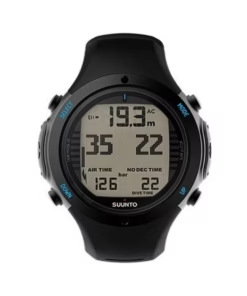
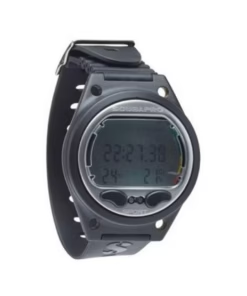
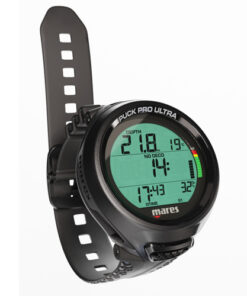
Mares Mission Digital Chrono Watch Instrument
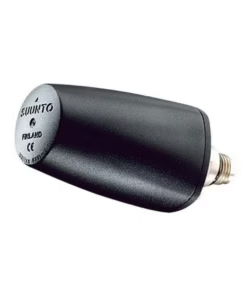
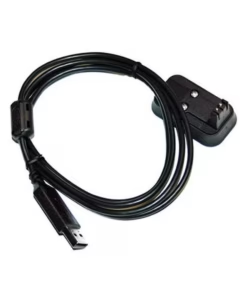
Suunto Helo 2 USB Interface cable
Mares EOS 10R Torch

✓  Free Shipping Over RM150|✓  Manufacturing Defect Exchange Guaranteed|✓  Expert Dive Advice Before & After Purchase|✓  100% Authentic Equipment Every Item

Filter By

Price Range


RM 8 RM 17,160

Filter By

Sub Categories


Filter By

Brands


Showing 81–100 of 115 products
Sort:

RM2,099.00
RM230.00
RM2,299.00
RM1,190.00
RM775.00
RM704.00
RM1,076.00
RM2,216.00
RM83.60
RM14.00
RM665.00

Buyer's Guide

Your Safety Instrument Underwater

A dive computer is the one piece of kit you can't compromise on. Real-time NDL tracking, ascent rate alerts and logbook functions protect every dive — from the reefs of Redang to the walls of Sipadan.

Get Dive Computer Advice

Algorithm

Dive Computer Decompression Algorithms Explained

Bühlmann and RGBM algorithms calculate nitrogen loading differently. Conservative settings add safety stops earlier — recommended for daily diving at Malaysian resorts where 3–4 dives per day is standard.

Air Integration

Wireless Air Integration: Is It Worth the Extra Cost?

Wireless air integration transmits tank pressure to your wrist computer, eliminating the need to read a console SPG. Useful for twinset diving and any diver who wants all data in one place.

Nitrox

Why Nitrox Mode Matters for Malaysian Reef Diving

Nitrox extends no-decompression limits on repetitive dives — allowing longer bottom times on the reefs of Redang, Tioman, and the Perhentians where 3–4 dives per day is standard.

Logging

Using Your Dive Computer's Logbook Function

Most modern dive computers log depth, time, temperature and ceiling data for every dive. Connect via Bluetooth or USB to a dive log app after each trip to build a complete dive record.

You Might Also Like

Recommended Products

Hand-picked products based on all categories

Diving Equipment

Zeagle Onyx w/ ZO Regulator

RM620.00
RM102.00
RM150.00
RM4,336.00

FAQ

Frequently Asked Questions

Everything you need to know before making a purchase

Should I choose a wrist computer or a gauges-and-console setup for Malaysian recreational diving?
Wrist computers are the more popular choice among Malaysian recreational divers because they consolidate depth, time, and NDL on a single display that stays visible during normal finning without any additional hand movements. Console setups suit divers who prefer an analogue pressure gauge as a battery-independent backup and find the larger console display easier to read during wreck dives at Malaysian sites where NDL management is continuous. Many experienced Malaysian liveaboard divers carry both - a wrist computer for dive planning and a console for tank pressure reference.
What algorithm settings should I use on a dive computer for multi-dive days at Malaysian sites?
A medium conservatism setting on a Bu00fchlmann or RGBM algorithm provides a practical balance for the three-to-four dives per day typical on Malaysian liveaboards without cutting bottom time so aggressively that afternoon dives become frustrating. High conservatism significantly shortens NDL as surface nitrogen accumulates across dive days - on a five-day Sipadan liveaboard this can reduce the third and fourth daily dive to under 30 minutes at 18 metres by day three. Maintaining surface intervals of at least 60 minutes helps reset tissue compartments and extends subsequent NDL allowances.
How do I configure nitrox mode for operators in Semporna and across Sabah?
Confirm the exact oxygen percentage from the operator's own analyser before every dive - EANx32 and EANx36 are the standard mixes in Semporna, but actual fill percentages can vary. Programming a lower percentage than the actual mix produces dangerously optimistic NDL readings. Carry a personal O2 analyser on liveaboards to verify mixes independently rather than relying solely on the operator's stated percentage, particularly at smaller operations where every fill may not be individually tested.
What dive computer features matter most for Malaysian recreational diving?
Core display functions - current depth, maximum depth, elapsed dive time, no-decompression limit, and ascent rate indicator - cover the practical information needs of Malaysian recreational diving at depths to 40 metres. An audible ascent rate alarm adds a safety backup at sites with upwelling currents around the Semporna islands where ascent speed can increase without the diver noticing immediately. Freediving mode is increasingly valued by Malaysian divers who combine scuba liveaboard schedules with breath-hold sessions between structured dives.
Where can dive computer batteries be replaced in East Malaysian dive towns?
CR2032 coin cells and AA batteries, covering the majority of recreational dive computer brands, are available at pharmacies and electrical shops in Kota Kinabalu, Tawau, and Sandakan. Replacing user-accessible batteries requires careful O-ring maintenance on the battery compartment - apply silicone grease to the O-ring and replace it every second battery change to maintain the waterproof seal. Dive computers with factory-sealed rechargeable cells require a service centre for battery replacement, making Kuala Lumpur the nearest practical option for most East Malaysian dive bases.
How do I assess a second-hand dive computer before relying on it in Malaysian waters?
Power on the computer and confirm it retains accurate date and time, indicating the battery and memory circuits are functional. Review the logbook memory for dive profiles showing missed decompression stops or oxygen limit breaches, which indicate the previous owner regularly pushed limits that may have compromised calibration integrity. A computer that has sat with a flat battery for more than a year should be sent to the manufacturer for algorithm calibration verification before being used for dive planning.
Should I choose a wrist computer or a gauges-and-console setup for Malaysian recreational diving?
Wrist computers are the more popular choice among Malaysian recreational divers because they consolidate depth, time, and NDL on a single display that stays visible during normal finning without any additional hand movements. Console setups suit divers who prefer an analogue pressure gauge as a battery-independent backup and find the larger console display easier to read during wreck dives at Malaysian sites where NDL management is continuous. Many experienced Malaysian liveaboard divers carry both u2014 a wrist computer for dive planning and a console for tank pressure reference.
What algorithm settings should I use on a dive computer for multi-dive days at Malaysian sites?
A medium conservatism setting on a Bu00fchlmann or RGBM algorithm provides a practical balance for the three-to-four dives per day typical on Malaysian liveaboards without cutting bottom time so aggressively that afternoon dives become frustrating. High conservatism significantly shortens NDL as surface nitrogen accumulates across dive days u2014 on a five-day Sipadan liveaboard this can reduce the third and fourth daily dive to under 30 minutes at 18 metres by day three. Maintaining surface intervals of at least 60 minutes helps reset tissue compartments and extends subsequent NDL allowances.
How do I configure nitrox mode for operators in Semporna and across Sabah?
Confirm the exact oxygen percentage from the operator's own analyser before every dive u2014 EANx32 and EANx36 are the standard mixes in Semporna, but actual fill percentages can vary. Programming a lower percentage than the actual mix produces dangerously optimistic NDL readings. Carry a personal O2 analyser on liveaboards to verify mixes independently rather than relying solely on the operator's stated percentage, particularly at smaller operations where every fill may not be individually tested.
What dive computer features matter most for Malaysian recreational diving?
Core display functions u2014 current depth, maximum depth, elapsed dive time, no-decompression limit, and ascent rate indicator u2014 cover the practical information needs of Malaysian recreational diving at depths to 40 metres. An audible ascent rate alarm adds a safety backup at sites with upwelling currents around the Semporna islands where ascent speed can increase without the diver noticing immediately. Freediving mode is increasingly valued by Malaysian divers who combine scuba liveaboard schedules with breath-hold sessions between structured dives.
Where can dive computer batteries be replaced in East Malaysian dive towns?
CR2032 coin cells and AA batteries, covering the majority of recreational dive computer brands, are available at pharmacies and electrical shops in Kota Kinabalu, Tawau, and Sandakan. Replacing user-accessible batteries requires careful O-ring maintenance on the battery compartment u2014 apply silicone grease to the O-ring and replace it every second battery change to maintain the waterproof seal. Dive computers with factory-sealed rechargeable cells require a service centre for battery replacement, making Kuala Lumpur the nearest practical option for most East Malaysian dive bases.
How do I assess a second-hand dive computer before relying on it in Malaysian waters?
Power on the computer and confirm it retains accurate date and time, indicating the battery and memory circuits are functional. Review the logbook memory for dive profiles showing missed decompression stops or oxygen limit breaches, which indicate the previous owner regularly pushed limits that may have compromised calibration integrity. A computer that has sat with a flat battery for more than a year should be sent to the manufacturer for algorithm calibration verification before being used for dive planning.